

Hike It Double? The Fed’s Real Decision Might Actually Be About Japan
In 2019, Playing With Fire* argued that the economic frameworks we’d inherited were already too blunt for the systems they were steering. In December 2025, Metastasis of Economic Frameworks returned to that argument to note the themes hadn’t resolved — they’d metastasised: monetary policy still operating on long, variable lags while markets moved at machine speed, central banks “fighting supersonic markets with subsonic tools.” Earlier this year, The Algorithms Don’t Wait for the Committee pushed the same diagnosis into the agentic-capital era. This piece continues that lineage, but it’s built around a live, dated decision rather than a diagnosis: the Federal Reserve meets on 15–16 September, ten days from this writing, and the honest case for what it should do is more interesting — and more conditional — than either side of the usual hike/hold argument admits.
The provocation, stated properly
The line that started this piece was blunt: if the data agrees a hike is warranted, the Fed shouldn’t dilute the response because of political pressure — hike it double. That instinct is sound. The wording needs two corrections before it survives contact with the actual mandate.
First, monetary policy and prudential regulation are related but distinct instruments, and neither operates above democratic review — operational independence is not institutional unaccountability. That distinction isn’t abstract this cycle: Chair Kevin Warsh took the gavel on 22 May 2026 after the narrowest Senate confirmation in the Fed’s history (54–45), and used his first Jackson Hole address as Chair, on 28 August, to say plainly that inflation is “still too high” and that the Committee “may have work to do” on rates. A chair confirmed on those terms has every incentive to prove the independence question wrong by acting on the data rather than around it — which makes the piece’s opening provocation about political pressure a live question about this specific Fed, not a generic one about the institution. Second, the Fed doesn’t have a private fiduciary duty to an undefined “aggregate.” Its authority is statutory: Section 2A of the Federal Reserve Act directs the Board and the FOMC toward maximum employment, stable prices, and moderate long-term interest rates. The defensible version of the thesis is narrower and more useful: the FOMC should exercise *instrument* independence within that mandate, and when a broad, pre-specified set of indicators shows inflation persistence threatening price stability, the Committee shouldn’t soften the response for political comfort. Fifty basis points may be warranted — but only when the expected benefit clears its distributional and financial-stability costs, not as a reflex.
That’s not “rule by markets.” It’s disciplined discretion: models structure the judgment, current data test it, and the policymaker keeps responsibility for the causal interpretation.
The evidence, checked against source before use!
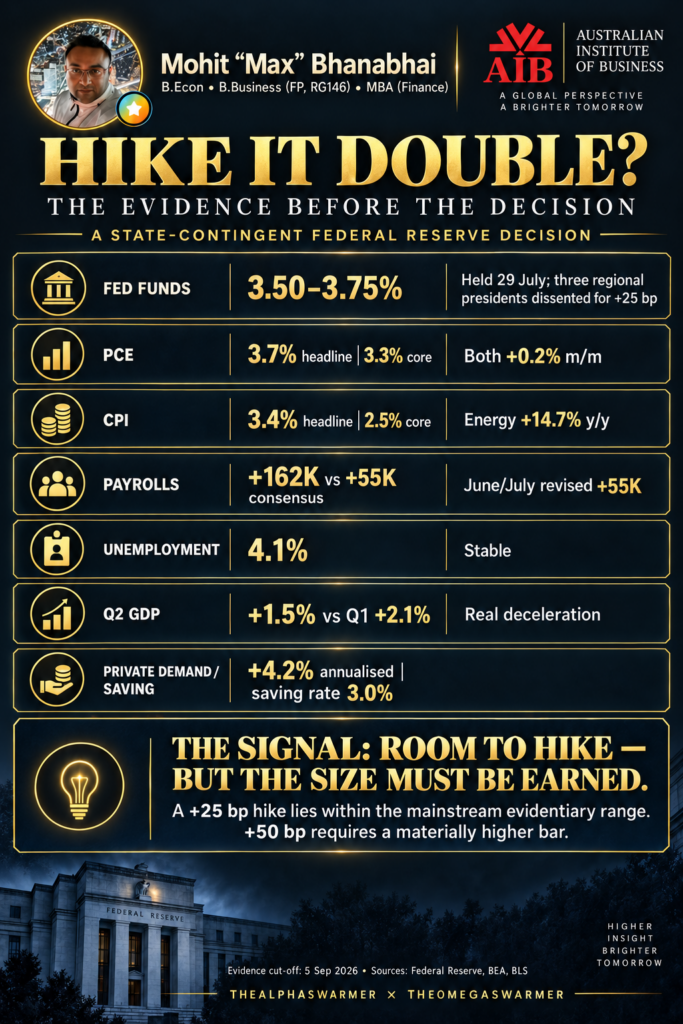
| Fed funds target | 3.50–3.75% (held 29 July; three regional presidents dissented for +25bp) | Room exists; a hike is already inside the mainstream range of opinion |
| PCE inflation (July) | 3.7% headline, 3.3% core, both +0.2% m/m | Materially above target |
| CPI (July) | 3.4% headline, 2.5% core; energy CPI +14.7% y/y | Headline pressure is real but energy-concentrated |
| Payrolls (August) | +162,000 vs. 55,000 consensus; June/July revised up a combined +55,000 | Labour demand can absorb tighter policy |
| Unemployment | 4.1% | Stable, not deteriorating |
| GDP | Q2 +1.5% (second estimate) vs. Q1 +2.1% | A real deceleration — worth taking seriously, not waved away |
| Private domestic demand | Real final sales to private purchasers +4.2% annualised in Q2 | Stronger than headline GDP suggests |
| Household saving rate | 3.0% (July) | Thin buffers — raises rate sensitivity |
Every one of these checks out against the primary release. The FOMC’s own July dissent — three presidents wanting 25bp now, not the full committee wanting to hold indefinitely — is itself evidence that a hike sits inside the mainstream evidentiary range, not on its fringe.
The case for a hike — and conditionally, a double one
In the standard New Keynesian setup, if expected inflation rises or the neutral real rate has drifted up on the back of resilient investment and productivity, an unchanged nominal rate quietly becomes less restrictive in real terms. A hike restores the restraint that was already assumed to exist. Taylor’s original policy-rule logic makes the same point more bluntly: the response to persistent inflation deviation needs to exceed one-for-one, or the real rate falls exactly when it should be rising.
The stronger version of the argument isn’t about punishment — it’s about the cost of delay. If firms infer tolerance for above-target inflation, they reprice faster; workers demand larger nominal gains; lenders build in bigger inflation premia. A larger move now can reduce the cumulative tightening needed later. And the Q2 divergence — 1.5% headline growth against 4.2% growth in private domestic demand — matters here: headline GDP was held down by trade and government-spending arithmetic, while the part of the economy monetary policy actually needs to read (households, private investment) held up better than the topline number implies.
The case against — and it’s substantial
July’s energy CPI ran at 14.7% while core sat at 2.5%. A policy rate can’t produce oil or reopen a shipping lane — tightening into a supply shock suppresses demand elsewhere to offset a relative-price move, which stabilises the headline number by imposing output loss that didn’t need to happen. The right test is whether the shock is *propagating* into wages and broad services, not whether the headline number is uncomfortable on its own.
Then there’s timing. Meta-analytic work on transmission lags puts the peak price response to a monetary shock at somewhere around two and a half years out, with real-time policy rules that look good on revised data performing considerably worse on the information actually available at the time of the decision — Orphanides’s core finding, and a genuinely humbling one for anyone tempted to act on a single release. A double hike risks stacking new restraint on top of restraint that hasn’t finished transmitting yet. Add to that the hysteresis risk that a deeper-than-necessary slowdown can permanently damage labour-force attachment and capital formation, and the financial-accelerator mechanism by which weaker borrower balance sheets amplify — not absorb — a rate shock, and the case against moving twice as hard is not a strawman. It’s real.
One specific caution matters more than the others: the 10-year Treasury yield is not a clean read on Fed expectations. It’s an amalgam of expected short rates plus a term premium that can move on fiscal supply, foreign duration flows, or plain risk appetite. Hiking *because* the 10-year rose risks double-counting tightening the bond market has already delivered on its own.
The argument this piece actually wants to make: the decision might not be about America
Here’s the part that doesn’t show up in a standard Fed-mandate analysis, and it’s worth being precise about rather than asserting it as settled fact.
The Bank of Japan meets on 17–18 September — one to two days *after* the Fed’s own 15–16 September decision. Market pricing currently implies roughly 63% odds of a BOJ hike at that meeting, and Governor Ueda has been open about deciding policy “with upside price risks in mind,” with some reporting suggesting the BOJ may be moving away from its historical cadence of roughly two hikes a year toward something faster. That sequencing — the Fed moving first, by about a day — is a real, dated fact for this specific cycle, not a hypothetical.
Why does the order matter this much? Go back to August 2024. The proximate trigger for that carry-trade unwind wasn’t simply that the BOJ hiked — it was that the BOJ delivered a hawkish surprise (raising its policy rate from near-zero to around 0.25%) at almost the same moment a soft US payroll print pulled forward Fed rate-cut expectations. Two central banks moved against the carry trade *simultaneously*, from opposite directions, and three months of ordinary position-unwinding compressed into a single Tokyo session. The Nikkei fell roughly 20% in less than a week — its worst stretch since 1987 — on an estimated $4 trillion of accumulated short-yen exposure globally.
The case for the Fed moving first and hawkish on 16 September, ahead of the BOJ’s own decision, is not that a wider absolute rate differential is automatically safer — it isn’t. A wider gap in isolation makes the yen-funded carry trade *more* attractive, which can just as easily encourage more positioning to build up rather than less, storing a larger problem for later. The more defensible version of the argument is narrower: it removes one specific, dangerous possibility — a *simultaneous* dovish-Fed, hawkish-BOJ surprise landing in the same 24–48 hours, which is the exact combination that turned an ordinary policy adjustment into a disorderly global deleveraging event in 2024. A Fed that has already moved, hawkishly, the day before the BOJ acts, faces the following week’s carry-market reaction as a sequenced adjustment to two already-known facts rather than a compounding double surprise.
That is a real, defensible mechanism — and it should be stated with exactly that much confidence, no more. It is a claim about *reducing the odds of a specific disorderly-sequencing scenario*, not a claim that a 50-basis-point hike makes the underlying carry-trade vulnerability disappear. The vulnerability itself — a still-enormous rate gap between a Fed holding near 3.6% and a BOJ likely still below 1% even after a hike — doesn’t go away because the Fed moved first; if anything, it persists at a higher level. It’s also worth being clear that this is a genuinely live concern in markets right now rather than a speculative one this piece is inventing: yen reverse-carry-trade fears citing the 2024 episode by name have already resurfaced in 2026 commentary, independent of anything in this analysis.
**This is the single clearest example of why the double-hike decision needs the full THEOMEGASWARMER layer structure rather than a domestic-only read.** A US-focused inflation model says “conditional yes, if persistence and expectations confirm.” An intermarket, transmission-aware model adds a second, genuinely distinct question: does the timing of this specific move reduce or increase the odds of a disorderly global deleveraging event in the following week? Both questions deserve an answer, and they don’t necessarily point the same direction.
The six-condition gate for the second 25 basis points
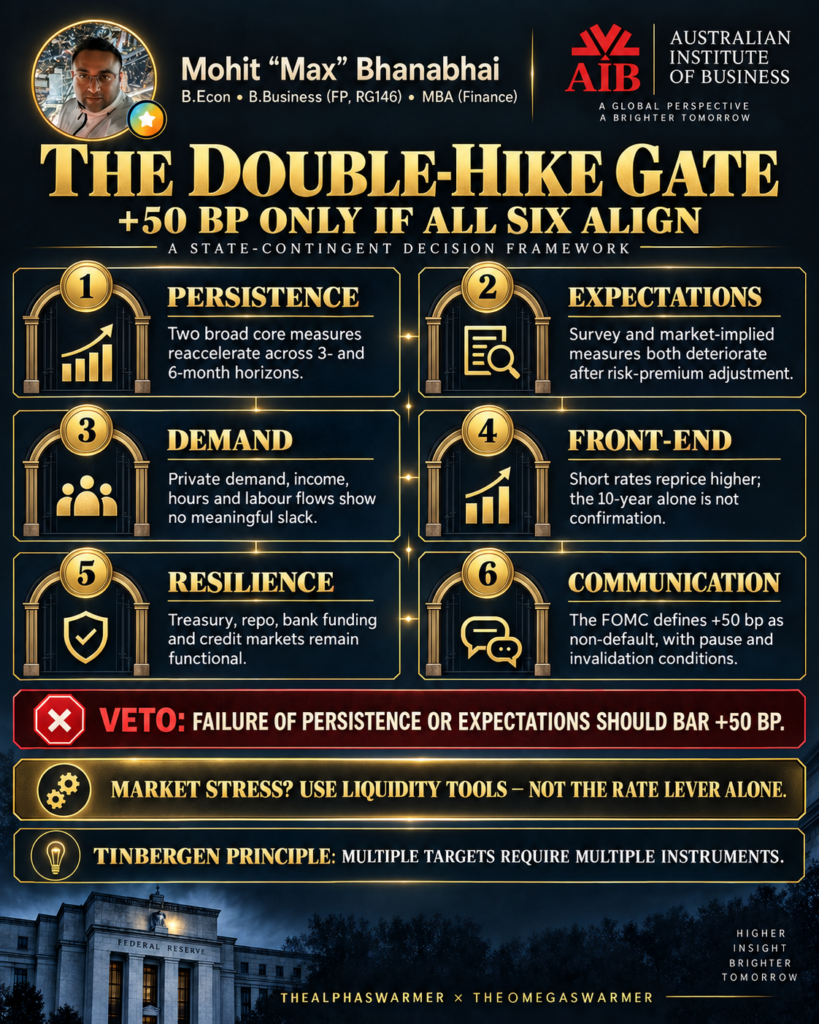
A 50-basis-point move should clear a materially higher bar than a 25-basis-point one, because rapid tightening carries its own nonlinear financial and employment risk. All six of the following should hold, not merely a majority:
1. **Persistence** — at least two broad core-inflation measures reaccelerating over three- and six-month horizons, not just the headline energy print.
2. **Expectations** — both a survey measure and a market-implied measure deteriorating after adjusting for risk premia.
3. **Demand** — private final demand, income, hours and labour flows remaining inconsistent with meaningful slack.
4. **Front-end confirmation** — the short end of the curve repricing higher, not just the 10-year (which, per the caution above, can rise for reasons that have nothing to do with expected policy).
5. **Resilience** — Treasury, repo, bank-funding and credit markets holding up functionally under the stress of the move.
6. **Communication** — the Committee stating plainly that 50 basis points is not a new default cadence, with explicit pause and invalidation conditions attached.
Failure of persistence or expectations should normally bar the double hike outright. Failure of resilience should trigger separate liquidity tools, not necessarily a softer inflation stance — Tinbergen’s instrument-target separation applies here directly: multiple objectives need multiple instruments, not one rate lever doing everything at once.
A note on the private chronology behind this
Part of the reasoning above draws on a personal, timestamped research chronology tracking US10Y, JGB, and DXY behaviour since 2024 — including a late-August 2026 note on a potential high-timeframe US10Y breakout and an early-September note connecting Japanese, German and US duration repricing to a curve-specific hedging framework. This is stated plainly: it is private, contemporaneous, ex-ante analysis, not an official data series or a peer-reviewed causal study.
It’s useful for showing the long-yield question was being asked before the latest labour release, not fitted to it after the fact — but it doesn’t, on its own, prove any particular policy conclusion. That still requires decomposing whether a given yield move reflects expected policy and inflation, or term premium and fiscal supply — the same distinction the case-against section already insists on.
What’s moved since this was first drafted
This piece was first written on 5 September, ten days ahead of the meeting it’s about. Three genuinely material things have happened since, and it’s worth being precise about what they do and don’t settle, in the same terms the rest of this piece uses.
First, the Fed side has repriced toward a coin flip. CME FedWatch now shows roughly a 50/50 split between a hold and a 25-basis-point hike at the 16 September meeting — up from odds that clearly favoured a hold when this piece was first drafted. That’s a market-implied shift, not a Committee decision, but it means the “conditional yes” base case argued for above is no longer the minority read; it’s the median one.
Second, the Japan side has moved further in the direction the Japan-overlay section already anticipated. Japan’s July inflation print came in at 1.9% year-on-year — the fastest reading of the year, and above what the BOJ had itself referenced going into its July decision — which is a direct contributor to the market repricing BOJ hike odds higher into the 18 September meeting. The yen has already responded: it strengthened more than 2% this week, touching a one-month high near ¥155.28, well off the ~¥160 level referenced in this project’s earlier Godzilla Margin Call research. That is the carry-trade-sensitive move this piece’s “Japan overlay” section describes — already underway in the market, before either central bank has actually acted. It supports the piece’s core mechanism claim without yet confirming its outcome: the market is pricing in the possibility of the exact sequencing this piece discusses, which is different from that sequencing having actually occurred.
Third, and most simply: none of this changes the six-condition gate above, or the invalidation criteria below. The 11 September CPI print and the 16 September FOMC decision — followed one to two days later by the BOJ’s own — are still the events that actually settle this, not the run-up to them. Per this project’s own call-classification discipline: the fundamental case has moved from *emerging* to *supported* on the strength of the Fed-repricing and yen-move evidence above; intraday and intraweek confirmation remain *pending* until the actual decisions land. Nothing here should be read as the thesis being confirmed — only as the pre-conditions for testing it becoming more concrete.
Recommendation, stated with the same discipline asked of everything above
At this evidence cut-off, the case supports a tightening bias, not an unconditional demand for 50 basis points. PCE and CPI both sit well above target; three sitting regional Fed presidents already back a quarter-point move; private domestic demand is genuinely resilient. But core CPI at 2.5%, a real GDP deceleration from 2.1% to 1.5%, a thin 3.0% household saving rate, and a long-yield rise that may be partly term premium rather than expected policy all argue for real caution before doubling the increment.
– **Base case:** a clearly communicated tightening bias, with a 25-basis-point move live if inflation breadth and demand hold through the 11 September CPI print.
– **Escalation case:** 50 basis points only if the six-condition gate is satisfied — especially persistence and expectations together, not either alone.
– **The Japan overlay:** if the FOMC does move on 16 September, doing so hawkishly rather than passively removes one specific, dated tail risk — a simultaneous dovish-Fed/hawkish-BOJ surprise landing within 48 hours of each other — without pretending the underlying carry-trade vulnerability has been resolved.
– **Invalidation:** don’t hike 50 if disinflation broadens, credit and hiring flows weaken materially, or the long-yield rise proves to be predominantly term premium rather than expected policy and inflation.
The strongest version of the original proposition was never “hike it double, regardless.” It’s this: when independent evidence streams agree that inflation persistence is becoming self-reinforcing, the Fed should act decisively — even by 50 basis points — without political interference. When those streams diverge, prudence requires causal decomposition, instrument separation, and an explicit statement of what would prove the decision wrong.
DISCLAIMERS:
*This piece extends [Playing With Fire](https://www.thealphaswarmer.com/2019/10/playing-with-fire-animal-spirits-ensconce-progress-and-trepidation-in-economies/) (2019), [Metastasis of Economic Frameworks](https://www.thealphaswarmer.com/2025/12/metastasis-of-economic-frameworks-augment-systemic-failures-a-prophecy-on-the-demise-of-monetary-policy/) (2025) and [The Algorithms Don’t Wait for the Committee](https://www.thealphaswarmer.com/2026/08/the-algorithms-dont-wait-for-the-committee-agentic-capital-and-the-terminal-lag-of-monetary-policy/) (2026). Scenario analysis and economic commentary — not investment advice, and not an official submission to any regulatory body in this form.*
References
Barro, R.J. and Gordon, D.B. (1983) ‘Rules, discretion and reputation in a model of monetary policy’, *Journal of Monetary Economics*, 12(1), pp. 101–121.
Bernanke, B.S., Gertler, M. and Gilchrist, S. (1999) ‘The financial accelerator in a quantitative business cycle framework’, in *Handbook of Macroeconomics*, Vol. 1C. Amsterdam: Elsevier, pp. 1341–1393.
Blanchard, O.J. and Summers, L.H. (1986) ‘Hysteresis and the European unemployment problem’, *NBER Macroeconomics Annual*, 1, pp. 15–78.
Board of Governors of the Federal Reserve System (2026) *Federal Reserve issues FOMC statement*, 29 July. Available at: https://www.federalreserve.gov/newsevents/pressreleases/monetary20260729a.htm.
Bureau of Economic Analysis (2026) *Personal Income and Outlays, July 2026*. Available at: https://www.bea.gov/news/2026/personal-income-and-outlays-july-2026.
Bureau of Economic Analysis (2026) *GDP (Second Estimate) and Corporate Profits, 2nd Quarter 2026*. Available at: https://www.bea.gov/news/2026/gdp-second-estimate-and-corporate-profits-2nd-quarter-2026.
Bureau of Labor Statistics (2026) *Employment Situation, August 2026*. Available at: https://www.bls.gov/news.release/pdf/empsit.pdf.
Kydland, F.E. and Prescott, E.C. (1977) ‘Rules rather than discretion: the inconsistency of optimal plans’, *Journal of Political Economy*, 85(3), pp. 473–491.
Havránek, T. and Rusnák, M. (2013) ‘Transmission lags of monetary policy: a meta-analysis’, *International Journal of Central Banking*, 9(4), pp. 39–75.
Orphanides, A. (2001) ‘Monetary policy rules based on real-time data’, *American Economic Review*, 91(4), pp. 964–985.
Rogoff, K. (1985) ‘The optimal degree of commitment to an intermediate monetary target’, *Quarterly Journal of Economics*, 100(4), pp. 1169–1189.
Taylor, J.B. (1993) ‘Discretion versus policy rules in practice’, *Carnegie-Rochester Conference Series on Public Policy*, 39, pp. 195–214.
Bank for International Settlements (2024) *BIS Bulletin No. 90: The market turbulence and carry trade unwind of August 2024*. Available at: https://www.bis.org/publ/bisbull90.pdf.
Federal Reserve Board (2026) *Keynote remarks by Chairman Warsh at the 2026 Jackson Hole Economic Policy Symposium*, 28 August. Available at: https://www.federalreserve.gov/newsevents/speech/warsh20260828a.htm.
CNBC (2026) *Japanese yen surges as BOJ rate bets and intervention talk grow*, 3 September. Available at: https://www.cnbc.com/2026/09/03/yen-japan-intervention-boj.html.
*Note: several additional academic references from the source manuscript (Fisher 1933, Keynes 1936, Phillips 1958, Friedman 1968, Phelps 1967, Romer & Romer 2004, Akerlof/Dickens/Perry 1996) are canonical, well-established works retained on the strength of prior confidence in their accuracy rather than freshly re-verified in this pass — worth a final citation-format check before any formal (non-blog) submission, consistent with the source manuscript’s own editorial note.*